
Home office built-ins for Edina remote workers: layouts that fit the room
By Alexei Ceban, founder of Loon Cabinetry. Written from our shop in Minneapolis, MN.
A lot of the home office work we do in Edina starts the same way. Someone bought a desk during the first work-from-home year, wedged it into a spare bedroom, and three years later they are still living with it. The desk is too shallow. The printer sits on the floor. Every video call shows a wall of cables behind their head. The room never got designed around the work. It just absorbed it.
That is the job a built-in does. It treats the office as a real room instead of a spot where a desk happens to land. The catch is that Edina houses are not interchangeable. A 1920s house in the Country Club District gives you completely different walls to work with than a 1958 rambler off Concord or a new build near 50th and France. The layout that fits one will fight the other. So this is less a list of features and more how I think about a room before I draw anything, which is also how we approach the home office built-ins we make for every house.
Start with the room you actually have
Before I talk depths and drawers, I walk the room and find the one wall that wants the built-in. In most Edina spare bedrooms that is the wall opposite the door, the one you see when you walk in. It reads as finished, and it keeps your back to a wall on calls. People underestimate that until they have spent a year with an open doorway behind their head.
Then I look at what is going to get in the way. Older Edina homes have a few recurring ones. Plaster walls that are rarely plumb. Picture rail you may want to keep. Cast iron radiators sitting right under the windows, which is exactly where people assume the desk should go. You can run a desk over a radiator, but it has to breathe or you cook your knees and your hard drive, so we box it with a slatted front and leave the back of the top open. Newer France Avenue rebuilds have the opposite problem. Big blank flex rooms with no character and one awkwardly placed data jack. Different rooms, different starting point.
The spare bedroom: one wall, and what goes on it
This is the most common Edina office we build. You have a ten to twelve foot wall and a door, and the goal is one continuous run that holds the desk, the storage, and the clutter.
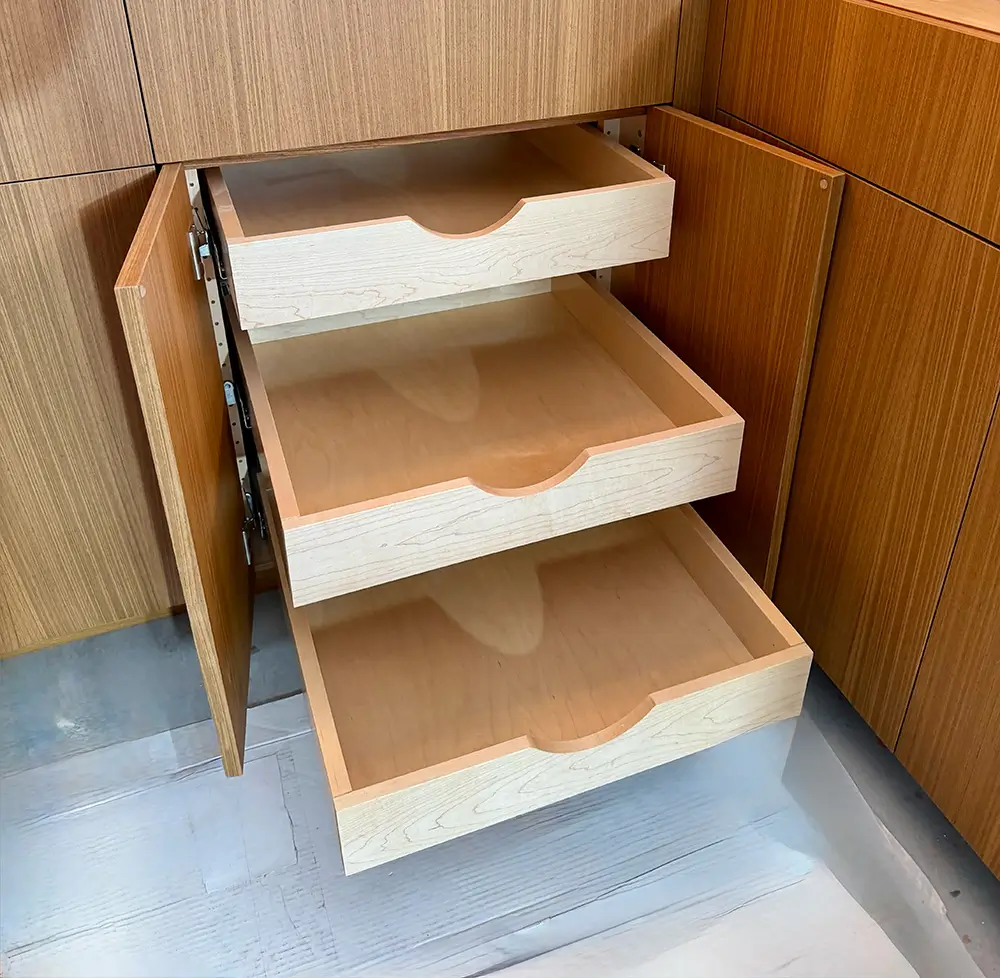
I keep the worktop at twenty nine to thirty inches off the floor and at least twenty four inches deep, thirty if the room allows. A deeper top lets the monitor sit back far enough that you are not craning at it all day. That number is not me guessing. OSHA’s guidance on desk and monitor setup puts the screen at least twenty inches away with your legs fully clear underneath, and a too-shallow surface is the single most common reason a builder-grade office feels wrong. On either side of the worktop I run full-height cabinets. One tower of real file drawers sized for hanging folders. One with a printer garage that is vented and sits on a pull-out, so you are not lifting the thing every time it jams.
Above the desk I would rather do open shelves than upper doors in a small room. Doors at eye level make a ten foot room feel like a galley kitchen. Open shelves with a strip of warm LED tucked under the lowest one cut the glare on your screen and give you a clean background for calls.
One question I get on almost every spare bedroom: can you build it to stand up and sit down? A fixed worktop cannot do both. What works is building the storage towers as the permanent piece and flanking a separate height-adjustable desk between them, or running the whole top at standing height if the person genuinely stands most of the day. I would rather tell you that up front than build you a beautiful desk you outgrow in a month.
Ramblers and split-levels: go around the corner
The 1950s and 60s ramblers around Cornelia, and the lower-level offices in Edina split-levels, usually give you two usable walls with windows on the rest. That is an L-shaped layout, not a single run. I put the main worktop along the longer wall and turn a shorter return into the corner for a second surface. That return is where most people end up keeping the things they do not want on the main desk.
Lower-level offices come with their own list. Ceilings are lower, so tall cabinets can feel heavy, and I will often stop the uppers short and add a floating shelf instead. There is usually an egress window you are not allowed to block. And basements move moisture, which is the real reason we build our boxes from furniture-grade plywood instead of particle board. Particle board swells the first humid August it sees. Plywood holds its shape.
Period homes: work under the windows, not against them
Country Club District houses and the older homes near the lakes are beautiful and a little stubborn. The rooms people want as offices were built as bedrooms or libraries, with windows on two sides and almost no blank wall. Fighting that is a losing game. Instead I run a shallower desk surface under the windows, eighteen to twenty two inches deep, with low cabinets below for files and a clear top for a laptop and a monitor on an arm. You keep the light, you keep the view, you keep the picture rail, and the cabinetry reads like it has always been in the house because it is painted to match the trim and built to the proportions of the room.
Two people, one room
Plenty of Edina couples both work from home now, and a spare bedroom becomes a two-desk office. Back-to-back desks need about ten feet so two chairs can roll out without knocking into each other. If the room is narrower, a galley layout with a run down each long wall works better, and you face opposite directions so neither of you is on camera during the other person’s calls. Sound matters more with two people in a room. A wall of cabinets and books does real work soaking up the echo that makes a hard-surfaced room sound like a call from a parking ramp.
The details that decide whether you actually use it
The layout gets people in the door. The details are what make it an office you keep working in. A few I will not skip. A wire chase behind a false back, so cords drop straight to a power strip instead of dangling down the wall. Grommets in the worktop where the monitor and laptop live. At least one drawer wired for power, so chargers stay inside and the desktop stays clear. Soft-close on everything, which sounds like a small luxury and turns out to be the thing you notice every single day.
If you want to see how these choices play out in finished rooms, our notes on home office built-in ideas and the mistakes we see most often in home office builds go deeper on specific rooms than I can here.
Why a local shop fits an Edina room better
We are a custom shop, which means the same people who measure your room are the ones who build it, finish it, and carry it up your stairs. Edina is a short drive from our Minneapolis shop, so the measuring visit and the follow-up are easy to schedule. That closeness is half of why a built-in fits an Edina room better than a desk you order online. We see the plaster that is not plumb, the radiator in the wrong spot, the ceiling that drops in the basement, and we build around all of it.
If you are weighing whether to do this in your house, the most useful next step is a consultation where we measure and talk through the room. You can see more of the custom cabinetry we build for Edina homes, or get in touch and we will set up a time. If your first question is cost, which it usually is, here is how we put an estimate together so the number is based on your actual room and not a guess.
Alexei Ceban is the founder of Loon Cabinetry, a custom cabinet shop in Minneapolis, MN that designs, builds, finishes, and installs cabinetry for Edina and the surrounding Twin Cities. Loon Cabinetry is licensed and insured.