
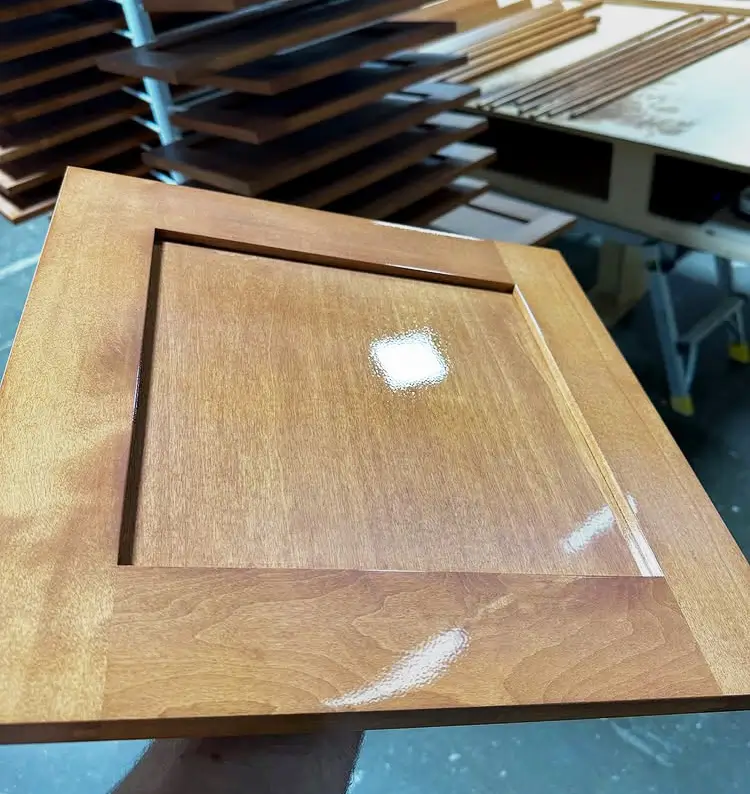
Cabinet makers near me: how to vet a local shop before you book a consultation
By Alexei, founder of Loon Cabinetry. Written from our shop in Minneapolis, MN.
When you search “cabinet makers near me,” you get a wall of names. Some are real shops with a saw and a finish room. Some are showrooms that mark up boxes built three states away. A few are guys with a truck and a website. They all look about the same on a phone screen, and that is the problem.
I have built custom cabinets in the Twin Cities for years, and I have also been the person who gets called in to fix work another shop walked away from. So I want to give you the checks I would run if I were the homeowner, before I ever filled out a contact form. None of this takes long. Most of it you can do from your couch in twenty minutes.
Start by figuring out what kind of “cabinet maker” you are actually looking at
The word covers four very different businesses, and the search results do not tell you which is which.
There is the true custom shop that designs, builds, finishes, and installs under one roof. That is what we do at Loon. There is the semi-custom dealer who sells a catalog line and modifies it a little. There is the big-box store that orders stock boxes and subcontracts the install. And there is the handyman who does cabinets between deck jobs.
None of these is automatically bad. A stock line can be the right call for a rental or a tight budget. But you need to know which one you are talking to, because the price, the timeline, and the quality swing hugely between them. The fastest way to tell: ask “do you build the cabinets yourselves, and where?” A real maker will answer in one sentence and probably invite you to come see the shop. A reseller will get vague.
Look at the actual work, not the homepage slider
Every cabinet website has a gorgeous hero photo. That photo might be a stock image. It might be one good project from 2019. What you want is volume and consistency: lots of real jobs, photographed in real homes, with the kind of detail that is hard to fake.
When you look through a shop’s project gallery, check whether the photos show the same hands across many kitchens, or whether they look like a Pinterest board. Look at the boring parts. Are the door gaps even? Do the drawers line up? Is the inside of the cabinet finished, or just the front? Anybody can make the door look nice. The inside is where shortcuts hide.
This matters more than it used to. Google’s March and May 2026 core updates both rewarded firsthand experience and real, demonstrable expertise over generic content. The same instinct works for you as a buyer. A shop that shows its real process and its real projects is showing you something a reseller cannot.
Confirm they are local in the way that counts
“Near me” is doing a lot of work in that search. A company can rank for “cabinet makers Minneapolis” and operate out of a warehouse two hours away, shipping in finished boxes and sending a crew on install day. If something goes wrong in week ten, you want a shop you can drive to.
So check the address. Is it a real workshop or a UPS Store suite number? Check the service area. We list ours plainly: Minneapolis, St. Paul, Edina, Chanhassen, Minnetonka, Plymouth, Maple Grove, and the surrounding suburbs. If a shop cannot tell you whether it covers your town, that is a small red flag with a big shadow.
Reading their local content helps too. Our piece on how long custom kitchen cabinets take in the Twin Cities exists because Minneapolis homeowners kept asking the same timeline question on the first call. A shop that writes for your area usually works in your area.
Read the reviews like a skeptic, not a fan
Five stars across the board can mean the work is great. It can also mean the shop has twelve reviews from family. Here is how I read them.
Sort by the lowest rating first and read every one- and two-star review. You are not looking for the existence of a bad review, because every busy shop collects a few. You are looking for the pattern. Three different people saying “they disappeared after the deposit” is a story. One person upset about a delivery date in a snowstorm is not.
Then read how the shop responded. A defensive, blaming reply tells you what working with them will feel like when something goes sideways. A calm “here is what happened and here is how we fixed it” tells you the opposite. Check the dates too. A shop with great reviews from 2021 and silence since may have changed hands or lost its lead carpenter.
Pin down how they handle money before you ever meet
The single most common bad-cabinet story I hear starts with a fuzzy payment arrangement. You do not want to discover the structure at signing. You want to know it before you spend an hour at a consultation.
A reasonable custom shop will explain its deposit and milestone payments without flinching. Big deposits that front-load most of the cost are the thing to watch. So is any shop that pressures you to pay the balance before installation is finished and you have inspected it. We walk through our whole money-and-milestones approach in our post on the 11 questions to ask before you sign a cabinet contract, and I would read that before any consultation, with us or anyone else.
Check that they will tell you what they build with
Materials are where the real quality difference lives, and a good shop is happy to talk about them. Ask what the cabinet boxes are made of. We use furniture-grade plywood because it holds screws better, resists moisture, and lasts. Some shops use particle board to hit a price, which is fine to know going in but miserable to discover later under a leaky sink.
If you want to understand why this choice matters so much, we broke it down in detail in our guide on plywood versus MDF versus particle board cabinet boxes. The point for vetting is simple: a maker who cannot or will not tell you what is inside the box is hiding the box for a reason.
Use an outside standard as a sanity check
You do not have to take any shop’s word, including ours. The National Kitchen & Bath Association keeps a public directory of certified designers and member professionals, and you can search it by location through the NKBA. It is a useful neutral reference point. Certification is not the only mark of a good maker, and plenty of excellent small shops are not listed, but it is one more independent signal you can stack on top of reviews and real photos.
What a good consultation should feel like
Once a shop clears all of that, the consultation is where you confirm it. A good one feels like a conversation, not a sales pitch. The maker asks how you cook, who uses the space, what drives you crazy about your current kitchen. They measure carefully. They are honest about what your budget can and cannot do. They do not need you to sign that day.
If you leave feeling rushed, upsold, or unheard, trust that. The way a shop treats you before you have paid anything is the most generous version of how it will treat you for the rest of the project.
The short version
Figure out what kind of shop it is. Look at real projects, including the inside of the boxes. Confirm they are genuinely local. Read the bad reviews and the responses. Understand the money before you meet. Ask what they build with. Cross-check against an outside standard like the NKBA. Then judge the consultation by how it feels.
That is the whole checklist, and it costs you nothing but a little time up front. It is a lot cheaper than fixing the wrong choice later.
If you are in Minneapolis or anywhere in the Twin Cities metro and want to put us through this exact test, that is fine by me. Come see the shop, ask the hard questions, and look inside the boxes. You can learn about how we work or request a quote whenever you are ready.
Loon Cabinetry designs, builds, finishes, and installs custom cabinets in Minneapolis and the Twin Cities, with no middlemen. Questions about a project? Contact us.