
How long do custom kitchen cabinets take? A week-by-week timeline from design to installed in your Twin Cities home
By Alexei, founder of Loon Cabinetry. Written from our shop in Minneapolis, MN.
The question I get on almost every first call is some version of “how fast can you do it.” Usually right after the homeowner has been quoted 20 to 24 weeks by a showroom and they think I’m going to be the hero who saves their Thanksgiving.
I’m not. Nobody is. But the real answer is more useful than the showroom answer, because it explains where the time goes, and that tells you which weeks you can compress and which weeks you can’t.
So here’s the honest version, week by week, the way it actually plays out for a custom kitchen project we build in our Brooklyn Park shop and install somewhere in the Twin Cities.
The short answer
For a fully custom kitchen built in our shop, designed from scratch, and installed in a home in Minneapolis, St. Paul, or one of the surrounding suburbs, plan on 10 to 16 weeks from the day you sign the contract to the day we leave your driveway.
That range is real. It’s not padding. The difference between 10 weeks and 16 weeks comes down to three things: how fast you make decisions, whether your kitchen involves a custom range hood or built-in appliances, and what the wood market looks like that month. I’ll get into all of that.
Before the contract signing there’s a design phase that adds another 2 to 4 weeks on the front end. I’ll cover that too, because most people don’t realize it counts.
Week 0: the consultation (before the clock starts)
You call us or fill out the form. We schedule a visit, usually within a week. I come out, measure the room, ask a lot of questions about how you actually use your kitchen, and look at things most designers don’t bother with. Where do you drop the mail. Which side of the sink do you stand on when you wash dishes. Whether you bake or just heat things up.
This visit is free and it takes about an hour and a half. You can read more about how we approach this in our piece on how to get an accurate estimate for your custom cabinets, which walks through what we measure and why.
This week doesn’t count toward the project timeline. Some people sit on the quote for a month. That’s fine. The clock starts at signing.
Weeks 1 to 3: design and material selection
Once you’ve decided to move forward, we go into the design phase. This is where most projects get stuck, and it’s almost never our fault.
Week 1, I send you a first draft of the layout with 3D renderings. Not a sales pitch render, just a working drawing you can react to. You look at it, mark it up, send it back. We talk about what doesn’t feel right.
Week 2 is usually the back-and-forth. Cabinet heights. Drawer stacks vs. doors. Whether the island has a prep sink. Whether the corner is a lazy susan, a blind cabinet with pullouts, or a magic corner. These are not small decisions and I’d rather spend a week on them than rip apart a finished cabinet later.
Week 3 is wood, finish, and hardware. Door style and species are easy. Stain or paint color is where things slow down. I’ll bring samples out to your house so you can see them in your actual light, because a white oak sample under shop fluorescents looks nothing like the same sample at 4pm in a kitchen with east-facing windows.
If you already know what you want when you sign, this whole phase can fold into 10 days. If you’re still deciding whether you want shaker or slab in week 3, we’ll add a week. Nobody benefits from a rushed door profile decision.
Weeks 4 to 5: shop drawings and ordering
This is the quiet phase. You don’t see much. I’m at my desk producing shop drawings — every cabinet, every drawer, every shelf, dimensioned, named, numbered.
At the same time we’re ordering. Cabinet boxes start as sheets of furniture-grade plywood. Doors are usually outsourced to a specialty mill if you’ve picked an unusual species or a specific door profile, and that’s where most lead-time variability lives. White oak is fine. Quarter-sawn rift white oak with a custom inset profile in November is a different story.
If you want to understand why we insist on furniture-grade plywood instead of particleboard, we wrote about it in how we build the most durable custom cabinets in Minneapolis. The short version: it costs us more, it lasts longer, and we don’t think there’s a real argument the other way for a custom kitchen.
Doors typically come in 3 to 5 weeks after we order them. Your door lead time, more than anything else, determines your install date. If a salesperson promises you a 10-week kitchen and the doors alone take 5 weeks, ask them what they’re cutting.
Weeks 6 to 9: building in the shop
This is where the cabinets become real objects.
Week 6: we break down sheet goods and cut all the cabinet box parts. Every panel gets labeled. The shop floor looks like organized chaos.
Week 7: dovetailed drawer boxes get built. Cabinet boxes get assembled, glued, and squared. We use mechanical fasteners plus glue on the joints, which is what separates a cabinet you’ll have in 30 years from one that racks loose after a couple of moves.
Week 8: face frames, where applicable. Inset doors need face frames built to tight tolerances or the reveal around the doors won’t be even, and uneven reveals are the single thing that makes a custom kitchen look not custom. We mill these on the same equipment we use for furniture work.
Week 9: pre-fitting. Every door, every drawer front, dry-fit to its opening before any finish goes on. If something needs to come back to the shop later, this is the week we’d rather catch it.
If your kitchen includes a custom range hood, it usually adds a week here, because hoods get built like a piece of furniture and have to be finished to match the perimeter cabinets exactly.
Weeks 10 to 11: finishing
Finish is where I see other shops cut the most corners and where we don’t.
Finishing room temperature, humidity, and dust control all matter. We spray with conversion varnish or 2K urethane depending on the finish, and each color requires multiple coats with full cure time between each one. Cure time is not the same as dry time. A door can feel dry in two hours and still be too soft to ship for two more days.
A painted kitchen with a complex color takes longer than a stained one. White and off-white paint finishes need 3 to 5 days. Deep colors and stains can run 7 to 10 days because they need more coats and the cure schedule is less forgiving. Glazes and distressing add another 2 to 4 days on top.
This is the week the project either feels like it’s flying or feels like it’s stuck, and it almost always feels stuck. I get the call. “Is everything okay?” Yes. The doors are drying. They have to dry.
Week 12 to 13: installation
Install is the part most people picture when they think about cabinet timelines. It’s also the shortest phase.
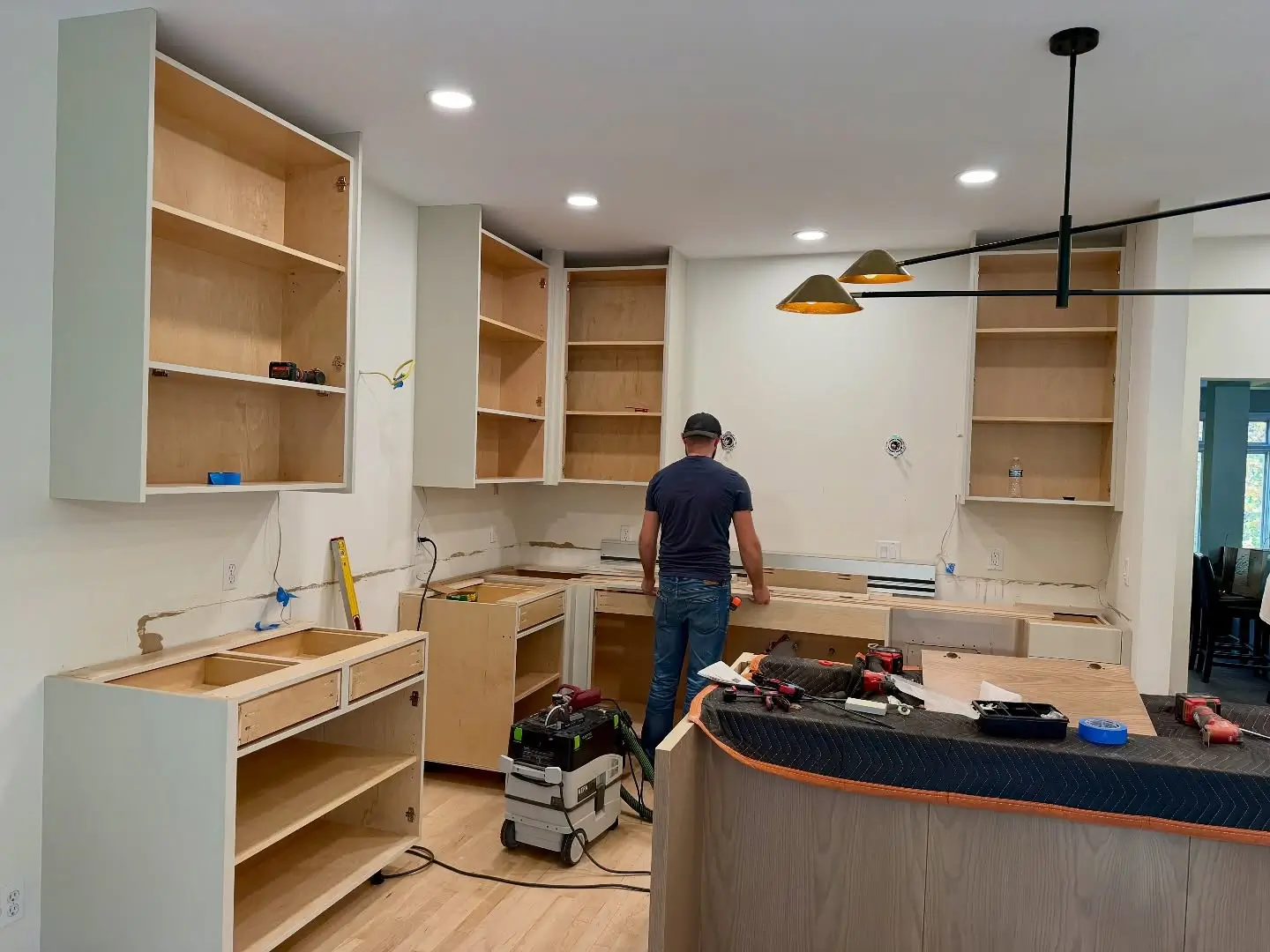
For a typical 25-linear-foot kitchen with an island, install runs 3 to 5 working days. Bigger or more complex layouts can stretch to 7 or 8. The crew arrives in the morning, the truck gets unloaded, the perimeter cabinets go in against the walls first, then the island, then the upper cabinets get hung and shimmed plumb.
Doors and drawer fronts go on last, after the boxes are installed and the countertop template has been done if your counter is going on top of cabinets we built. The reason is simple: the cabinets need to be perfectly aligned before the doors go on, because that’s when you see whether the reveals are even.
If you have built-in appliances — a panel-ready fridge, a wall-oven stack, a microwave drawer — those get installed by us in coordination with your appliance installer. We do the cabinetry side, they do the electrical and the plumbing connection.
There’s also a punch-list day at the end. Not a “we’ll come back if there’s a problem” day. A scheduled day where we walk through the kitchen with you, you point at every micro-issue you can find, and we fix it before we sign off. You can read more about how that fits into the rest of the process on our services page.
What makes a project longer
A few things consistently push timelines.
Custom range hoods. Already mentioned. Add a week.
Inset doors. The fit-up is harder and the door order takes longer. Add 1 to 2 weeks total, mostly in finishing.
Painted finishes in deep or saturated colors. Add 4 to 7 days in finishing.
Specialty species. Rift white oak, walnut with specific grain matching, or anything quartersawn will add 1 to 3 weeks at the door-order stage.
Indecision in design. The single biggest variable. The homeowner who can’t pick a paint color in week 3 is the same homeowner who calls in week 9 wanting to move the island, and now we’re rebuilding two cabinets and pushing install by two weeks. I don’t say this to be harsh. It’s your house. But the decisions you make early are the ones that stay easy.
Homes outside the metro core. If you’re in St. Paul, Edina, Minnetonka, or one of the closer suburbs, install scheduling is straightforward. If you’re an hour out, we sometimes have to phase the install across two trips, which can add days.
What does not make a project shorter
Paying more does not make custom cabinets faster. You can pay for premium materials, premium finishes, premium hardware, and you should. But the wood still has to dry, the finish still has to cure, and the doors still have to be ordered and shipped from the mill. When someone promises you a true custom kitchen from scratch in 6 weeks, they’re almost always using stock boxes with custom doors, which is fine but isn’t fully custom, or they’re skipping cure time on the finish, which you’ll notice in about 18 months when the paint starts wearing through on the drawer fronts you touch every day.
When you should start
Work backwards from when you actually want to be cooking in the new kitchen.
If you’re aiming for Thanksgiving, sign by the second week of August. That gives you a 16-week buffer, which sounds like a lot until your doors get back-ordered. A Fourth of July deadline means signing by late March. If you want to be done before the kids are home for summer break, mid-February.
These dates assume you can make decisions in the design phase. If you can’t, sign earlier and use the extra time on the front end. The worst rushed kitchens I’ve seen all came from homeowners who tried to compress design rather than build, and that’s the opposite of where the time should come from.
One last thing
I’ve written a few of these timeline posts over the years and I’ve noticed how much of what’s online about cabinet lead times is either marketing fluff from companies that don’t actually build, or copied from somebody else who copied it from somebody else. Google’s own Search Essentials ask publishers to make their content “helpful, reliable, people-first,” and I think that’s a reasonable bar for anyone writing about their own trade. The numbers in this post are from projects we finished in the shop this year. Yours may be a week shorter or three weeks longer. But they won’t be six.
If you’re a few months out from starting, the most useful thing you can do is come to the shop and look at samples in person before you sign with anyone. Bring your floor plan. Bring your spouse, or whoever has opinions about the kitchen. We’ll put the kettle on.
Set up a consultation, or take a look at some of our recent projects if you want to see what we’ve been finishing lately.
— Alexei