
Kitchen island cabinetry ideas for Twin Cities open-concept homes
By Alexei, founder of Loon Cabinetry. Written from our shop in Minneapolis, MN.
The island is the part of an open-concept kitchen that everybody sees and almost nobody plans well. It sits in the middle of the room, it faces the living space, and it does about five jobs at once. Plan the cabinetry around those jobs and the whole floor plan works. Skip that step and you end up with a beautiful slab of stone sitting on storage you cannot reach, next to seating nobody uses.
I build custom kitchen island cabinetry for homes all over the Twin Cities, and open-concept layouts bring their own set of questions. The island is no longer tucked into a galley where only the cook sees it. It is furniture now. It has a front and a back, and both of them are on display. So here is how I think through an island for an open floor plan, from the storage inside to the seating outside.
Start with how the island faces the room
In an open concept, the island is the dividing line between the kitchen and everything else. That means it has two faces with two different jobs.
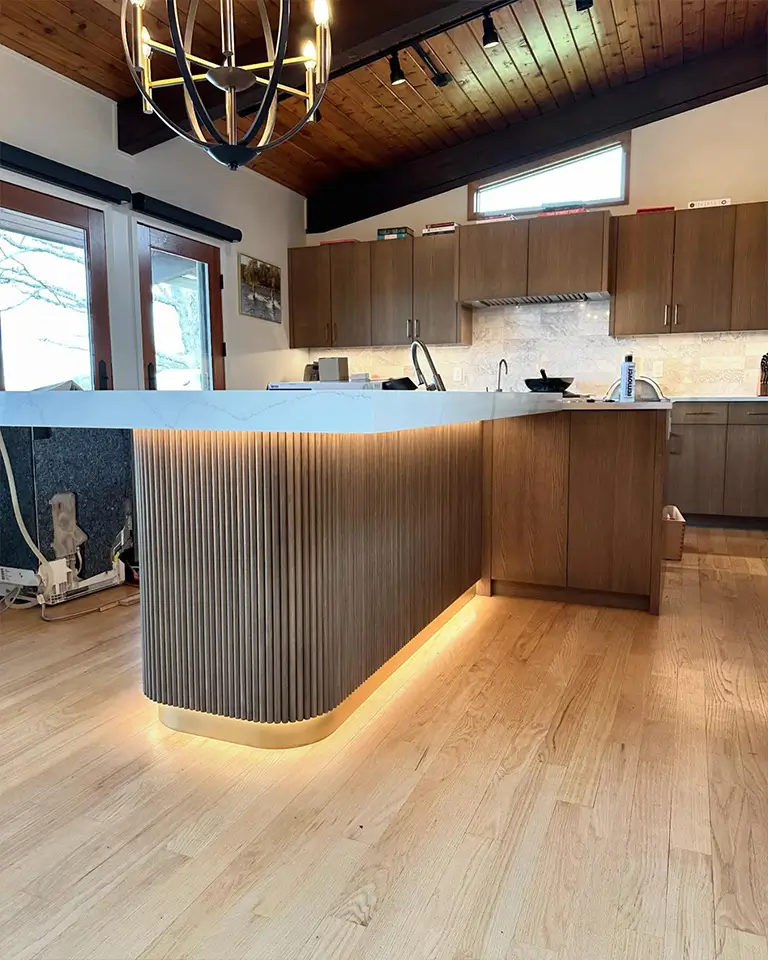
The kitchen side does the work: deep drawers, a prep zone, maybe the sink or cooktop. The living side is what your guests stare at from the couch, so it should look like a piece of furniture, not the back of a cabinet run. We often finish that side with full-height panels, a bit of trim detail, or open shelving for cookbooks and the things you actually want on display. The two sides do not have to match the perimeter cabinets either. A contrasting island is one of the easiest ways to give an open kitchen a focal point without painting the whole room.
Build the storage around what you actually keep
The biggest island mistake I see is storage chosen by habit instead of by contents. Somebody orders a row of identical doors, and then spends years stacking pots in a cave they have to kneel to reach.
Deep drawers beat doors for almost everything heavy: pots, pans, mixing bowls, small appliances. They roll out, so you see the back without crawling. For an island near the sink, a pull-out trash and recycling pair is worth its weight, especially in an open plan where you do not want a visible bin. If you bake, a deep drawer sized for sheet pans and a dedicated spot for the stand mixer saves your counters. And if the living side has open shelving, plan it for real objects you own, not styling props you will buy once and dust forever.
The material under all of this matters more than the door style. We build island boxes from furniture-grade plywood because an island takes abuse from all four sides and often carries a stone top that weighs a few hundred pounds. If you want the full reasoning, we wrote about why we build with plywood instead of MDF or particle board in a separate post.
Decide on seating before you fall in love with a size
Seating is where open-concept islands earn their keep, and where the math gets real. People want to sit where the action is, so the island becomes the breakfast bar, the homework table, and the spot guests gravitate to while you cook.
To seat people comfortably, plan about 24 inches of width per stool and real knee space underneath. A 30-inch-high counter wants roughly 18 inches of knee depth; a raised 36-inch bar wants about 15. If you try to squeeze four stools into a four-foot run, everyone eats with their elbows pinned. Better to seat three people well than four people badly. Decide how many seats you truly need, then size the island to fit them instead of the other way around.
Respect the clearances, because an open kitchen is a hallway too
This is the part open-concept homeowners underestimate. When the kitchen opens to the living room, people walk through it constantly, not just to cook. Your island cannot choke that traffic.
As a working number, leave at least 42 inches between the island and the surrounding cabinets for a single cook, and closer to 48 inches if two of you are in there at once. These come straight from the National Kitchen & Bath Association, and you can read their full kitchen planning guidelines on the NKBA site if you want the complete set. The reason I push on this: in an open floor plan, a too-big island looks impressive in a drawing and feels like a roadblock in real life. I would rather give you a slightly smaller island with room to move than a giant one you have to sidestep every day. A piece of painter’s tape on the floor before you commit tells you more than any rendering.
Match the island to the way Twin Cities homes are built
Open-concept renovations around here often come out of older homes where a wall came down between the kitchen and dining room. That history shapes the island. Ceiling heights, the direction of the floor joists, where the plumbing and electrical already run, all of it affects whether you can put a sink in the island or how big it can get.
It also affects timeline, which is why we talk it through early. If you are mapping out a remodel, our guide on how long custom kitchen cabinets take in the Twin Cities walks through where an island fits in the schedule. And if you want to see how islands read in finished rooms, our project gallery has a few open-concept kitchens worth a look.
A few ideas worth stealing
Some specifics that tend to work well in open layouts. A waterfall end panel gives the living side a clean, furniture-like finish. A second sink or a beverage drawer on the island keeps guests out of the main work zone. A mix of drawers on the kitchen side and open shelving on the living side covers both jobs at once: the heavy stuff stays hidden where you work, and the cookbooks sit out where people see them. A slightly different finish or wood tone from the perimeter turns the island into the anchor of the whole room. None of these cost much extra to plan in from the start, and all of them are painful to add later.
The short version
Treat the island as two-sided furniture, not just a counter. Build the storage around what you own. Size it around the seating you will actually use. Protect your walkways, since an open kitchen is also a path through the house. And plan the details early, because an island is the hardest thing to change once the stone is set.
If you are anywhere in Minneapolis or the Twin Cities metro and thinking through an open-concept kitchen, we can help you design an island that fits the room and the way you live in it. Take a look at our custom kitchen cabinetry work, or request a quote when you are ready to start.
Loon Cabinetry designs, builds, finishes, and installs custom cabinets in Minneapolis and the Twin Cities, with no middlemen. Questions about an island or a full kitchen? Contact us.